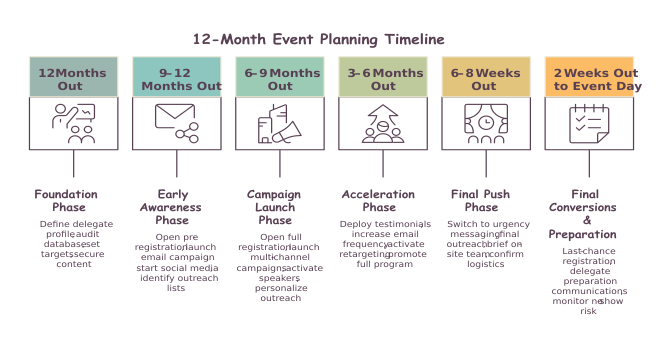
Delegate Acquisition Timeline Summary
|
Pros
|
When
|
Key Actions
|
|---|---|---|
Not by a day or a week. By months. They spend six months perfecting the programme, securing headline speakers, and finalising the venue, then turn to marketing with eight weeks left and wonder why registrations are slow.
By then, the damage is already done. Corporate delegates who needed to book travel and budget approval have already committed elsewhere. International attendees who needed visa arrangements never got the chance to consider your event. Sponsors who wanted a strong delegate list before signing contracts have gone cold.
The single most common question we hear from conference organisers at Markely Agency is: “When should we have started?” The honest answer is usually: earlier than you did.
This guide gives you the definitive answer; a phase-by-phase delegate acquisition timeline for B2B conferences, association congresses, and exhibitions, from 12 months out to event day. Use it to plan your next event. Use it to diagnose what went wrong with your last one.
Delegate acquisition is not a tap you turn on when you’re ready. It’s a sequence of overlapping campaigns, each one building on the last and each one dependent on decisions and assets that need to be in place before it can launch.
The reason most events fall short of their registration targets is not the marketing itself. It’s the timing. Corporate attendees need approval cycles that can take four to six weeks. International delegates require time to arrange travel and accommodation. Speakers and sponsors expect promotional lead time. When you start late, you’re already fighting an uphill battle — and every week you delay compounds the problem.
There is also a less obvious cost to starting late: you lose the compounding effect of early registrations. Early registrants become advocates. They tell colleagues. They share the event on LinkedIn. They create organic interest that a last-minute paid campaign can never replicate.
Research shows that 67.6% of event attendees buy earlier when early-bird discounts exist and 32.6% of attendees buy tickets more than a month ahead of the event.
That early momentum is only available if your campaign is running early enough to capture it.
The timeline below is structured around a 12-month lead time which is the recommended minimum for a large B2B conference or international congress. Shorter lead times are addressed separately at the end.

Twelve months out is not the time to start emailing potential delegates. It is the time to put everything in place so that when campaigns launch, they have something to work with.
Define your delegate profile precisely
Who is your ideal delegate? Not just their job title rather their seniority level, the types of organisations they work in, the professional challenges that would make your event worth attending, and the decision-making process they go through before committing to an event. The more specific this definition, the more targeted every subsequent campaign can be.
Contact data decays 20–30% annually.
A database that worked well for last year’s event is already partially out of date. Run a data audit now: identify lapsed delegates, update contact records, flag high value past attendees for personalised outreach later in the campaign and identify the gaps in your data that need to be filled before campaigns launch.
How many delegates do you need to make the event financially viable? What is your target attendance? What does a qualified delegate look like versus a warm lead? Setting these numbers now gives every phase of the campaign a clear performance benchmark to measure against.
Headline speakers, a confirmed venue, and a clear event proposition are the three things that give potential delegates a reason to register early. Without at least one confirmed speaker or a compelling programme angle, your early-bird campaign has nothing to sell. Start working on these now so they are ready when campaigns launch.
This phase is about awareness, not conversion. Your target delegates are not ready to register yet — but you want your event to be the one they already know about when they are.
Even if registration is not open, a save-the-date landing page capturing email addresses gives you a head start. Anyone who registers their interest at this stage goes straight to your highest-priority outreach list when full registration opens.
The sweet spot for most associations is three to four months before the event for the main marketing push — but past attendees should be contacted earlier. Past delegates are your highest-converting audience segment. They already know the event, already trust the brand, and need less persuasion than a cold prospect. Contact them first, before anyone else, with a personal tone that acknowledges their past attendance.
Start building the event’s social presence now — not to drive registrations, but to establish the event in your audience’s feed before the promotional campaign begins. Speaker profiles, industry thought leadership, and event theme content all build warm awareness that makes the later promotional push more effective.
Which industry associations, professional bodies, and membership organisations reach your target delegate profile? Which LinkedIn groups, industry publications, and sector-specific media are your audience reading? Map these out now. Building relationships with these channels takes time — and the organisers who get their event featured in the right industry newsletter are the ones who started the conversation months earlier.
This is the most critical phase of the entire timeline. For a large paid conference, you want targeted delegates to register early; weeks, if not months, ahead of the event. The early-bird period is your single most powerful conversion mechanism, and it only works if your campaign is running with enough lead time to generate momentum before the deadline.
The early bird deadline is your most powerful marketing moment for creating urgency. Structure your pricing tiers clearly: an early-bird rate that creates genuine incentive to register now, a standard rate that removes that urgency, and a late rate for the final weeks. Each tier should feel like a distinct opportunity, not an arbitrary price change.
Email marketing, LinkedIn advertising, paid digital, and direct outreach should all launch simultaneously at this phase and not sequentially. Your target delegates will encounter your event through different channels at different moments, and consistency across all of them builds the frequency of exposure that drives conversion.
Confirmed speakers have professional networks that overlap directly with your target delegate profile. A personal recommendation or social post from a confirmed speaker is worth more than most paid campaigns — and it costs nothing beyond the relationship. Brief your speakers now and give them shareable content that makes promotion easy.
A generic email blast to your full database is not a delegate acquisition strategy — it is the floor, not the ceiling. Alongside the broad campaign, run a parallel track of personalised outreach to the highest-value prospects on your list: past attendees who haven’t registered yet, senior executives who match your delegate profile, and contacts who have engaged with previous event communications but never converted.
By this point, your event should have visible momentum, a growing registration list, active social engagement, and confirmed speakers generating organic interest. This phase is about accelerating that momentum and converting the prospects who are aware of the event but haven’t committed yet.
92% of people trust recommendations from individuals over branded content.
The organisers who do this well are deploying testimonials from past delegates, speaker endorsements, and sponsor statements across every channel and not just on the event website. Emails, LinkedIn posts, retargeting ads, and direct outreach should all carry social proof from this phase onwards.
The contacts on your database are not all in the same place in their decision-making process. Segment by engagement level and tailor the messaging accordingly: re-engagement sequences for contacts who opened emails but didn’t register, conversion sequences for contacts who visited the registration page but didn’t complete, and nurture sequences for contacts who are still in early awareness. Each segment needs a different message.
Anyone who has visited your event website, clicked an email link, or engaged with your social content is a warm prospect. Retargeting campaigns keep your event in front of these prospects across LinkedIn and display advertising — maintaining visibility through the consideration phase without relying on them to come back to you unprompted.
“X delegates already registered” is one of the most effective conversions prompts you can use and particularly for professionals who are trying to get internal approval or budget sign-off. Real momentum is the most credible form of social proof. Share registration milestones, sold-out session announcements, and delegate list highlights (by sector or seniority) to build FOMO in the prospects who haven’t committed yet.
By this point, your full programme should be confirmed and actively promoted. The detailed session agenda, confirmed speaker list, and networking opportunities are the final decision triggers for many corporate delegates — particularly those who need to justify the attendance cost to a manager or finance team. Make the programme easy to find, easy to share, and clearly tied to professional development outcomes.
22% of event attendees buy tickets within two to four weeks of the event.
This is the last-chance audience who have been aware of your event for months but haven’t yet committed. The goal of this phase is to remove every remaining barrier to registration and create the urgency that converts consideration into action.
Early-bird pricing is gone. The message now is availability such as limited places, final registration deadline, and the cost of missing out. Countdown timers, “X places remaining” messaging, and final-deadline email sequences all drive conversion in this phase.
Every senior prospect who received your personalised outreach in the launch phase but hasn’t registered deserves a direct, personal follow-up. Not an automated email — a personal one. This is the highest-conversion activity you can do in the final weeks, and it is routinely skipped by organisers who run out of time. Don’t skip it.
Delegate acquisition does not end at registration. The on-site experience — how delegates are welcomed, how smoothly check-in runs, how well the event delivers on its promises — directly determines whether they return next year and whether they recommend the event to colleagues. Brief your event staffing team thoroughly and ensure the on-site delegate experience matches the expectation set by six months of marketing.
Keep registration open as late as your logistics allow. Some corporate delegates genuinely make final decisions in the last two weeks. A simple “registration closes in 48 hours” email to your unconverted list will always generate some final conversions.
Every registered delegate should receive a structured pre-event communication sequence: confirmation details, venue information, programme highlights, networking preparation guides, and any pre-event content that builds anticipation and reduces no-shows. A well-prepared delegate is a more engaged one — and a more likely returning one.
Not every registered delegate will arrive. In some markets, particularly across the Middle East delegate no-show rates can reach 50%. Build contingency into your registration targets and consider confirmation calls or WhatsApp reminders for high-value delegates in the final week.
Not every event has a 12-month runway. Here is how to adapt the timeline for shorter lead times:
Compress the Foundation and Early Awareness phases into the first two weeks. Launch campaigns immediately. Prioritise past delegates and your existing database over any new list-building. Accept that you will not capture the full early-bird momentum — and plan your pricing strategy accordingly.
For a paid virtual event, 28 to 20 weeks is the recommended lead time at three months, you are at the minimum viable window for a paid in-person event. Everything must run simultaneously. Expect a heavier reliance on paid digital channels to compensate for the shorter organic build. Focus on direct personal outreach to the highest-value prospects rather than broad awareness campaigns you don’t have time to convert.
This is crisis territory. At this lead time, broad delegate acquisition campaigns will not have time to convert. Focus exclusively on three activities: personal outreach to past delegates, direct contact with your highest-value prospect list, and a heavily discounted last-chance registration offer. Consider bringing in a specialist delegate acquisition agency who can activate existing databases and outreach infrastructure immediately.
Having the right timeline on paper is not enough. The single factor that most commonly derails even well-planned delegate acquisition campaigns is the late delivery of campaign assets — event websites that aren’t ready when registration launches, speaker content that arrives after the programme announcement, design assets that hold up the email campaign.
Delegate acquisition is a campaign that requires everything else to be ready before it can run. The best investment you can make in your timeline is working backwards from your campaign launch date and setting internal deadlines for every asset — website, speaker announcements, programme, pricing — that your campaigns depend on.
Start earlier than you think you need to. Because in delegate acquisition, the window to recover from a late start is much narrower than most organisers realise.
Markely Agency works with conference organisers, associations, and PCOs across the UK, USA, UAE, and Saudi Arabia to build and run delegate acquisition campaigns that start at the right time and deliver consistent results.
Whether you’re planning 12 months out or working with a tighter window, we can help you build the right campaign structure, activate the right channels, and hit your registration targets.
|
Pros
|
When
|
Key Actions
|
|---|---|---|